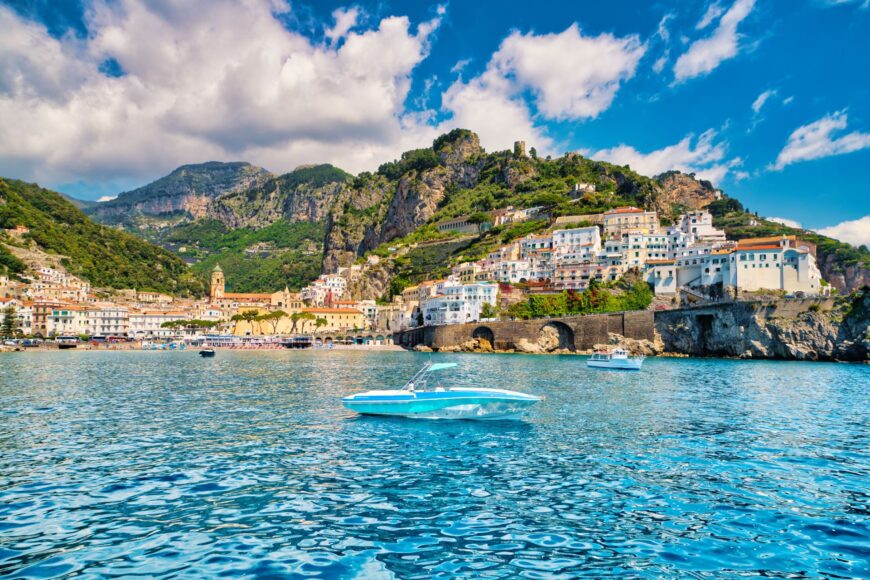
The time of year when the Amalfi Coast reaches the height of its essence—where the art of slow living blends seamlessly with joy and carefree moments—is August. The light takes on a warm, golden glow, the sea shimmers with deep sapphire reflections, and the air is filled with its unmistakable scent, mingling with the fragrance of sun-ripened lemons.
For the traveler admiring the Divine Coast from the deck of a ferry, August 15th may seem like just another summer day. But for those who live here, know these places intimately, and cherish their soul, it marks a meaningful turning point. It is the day when an ancient Roman imperial tradition intertwines with profound Marian devotion, seasoned with the sharp wit and good-humored irony that make the people of the Amalfi Coast truly one of a kind.
In this story, we invite you to discover Ferragosto as it is experienced here—not through the eyes of a passing visitor, but through the perspective of those who fall in love with this land and its breathtaking landscapes every single day.
From Emperor Augustus to the Assumption of the Virgin: The Evolution of a Sacred Holiday
To truly understand the spirit of Ferragosto, we must journey back more than two thousand years.
The word Ferragosto comes from the Latin Feriae Augusti—”the Rest of Augustus”—a holiday established by Emperor Augustus in 18 BC. Its original purpose was to grant farmers and working animals a well-deserved period of rest after the exhausting harvest season. Throughout the Roman Empire, horse races, public feasts, and festive celebrations were held. It was a time of peace, when the rhythm of labor gave way to renewal and restoration.
As centuries passed and Christianity spread, this pagan celebration of rest and the fertility of the land was not abandoned. Instead, in the 7th century AD, the Catholic Church incorporated it into the liturgical calendar, dedicating August 15th to the Solemnity of the Assumption of the Blessed Virgin Mary.
From that moment on, throughout the villages clinging to the cliffs of the Amalfi Coast, the celebration of the earth gradually became an act of profound devotion to the Virgin. The prayers once offered for abundant harvests transformed into prayers for the sea, asking for the protection of sailors, fishermen, and all those whose lives depend upon the Mediterranean.
The Sacred Climb: Pilgrimage to the Sanctuary of Madonna dell’Avvocata
For those wishing to experience Ferragosto away from the lively beaches and discover a more intimate, contemplative, and authentic side of the celebration, tradition leads upward.
Perched high above the rooftops of Maiori, on the majestic Mount Falerio overlooking the sea, stands the Sanctuary of Madonna dell’Avvocata. Every year, pilgrims and hikers alike take part in the traditional scarpinata—a demanding pilgrimage on foot requiring determination and devotion.
The route winds along ancient stone stairways and scenic trails surrounded by Mediterranean vegetation, where the scents of myrtle, juniper, and wild fennel perfume the air. Reaching the summit at dawn, as the first rays of sunlight illuminate the Gulf of Salerno, is an unforgettable experience. Suspended between the blue of the sky and the sea, visitors are embraced by a profound sense of peace that beautifully contrasts with the vibrant energy of the coastline below, creating the extraordinary feeling of being just a little closer to heaven.
Maiori and Positano: Between Faith, Legend, and Friendly Rivalry
The spiritual heart of Ferragosto beats strongest in two of the Amalfi Coast’s most beloved towns: Maiori and Positano, both deeply devoted to the Virgin Mary, celebrated in Maiori as Santa Maria a Mare.
In Maiori, devotion to the Virgin has always been the cornerstone of community life. The solemn celebrations held in the magnificent Collegiate Church attract worshippers from across the coast. This deep-rooted faith and the enthusiastic participation of local residents inspired one of the area’s most famous humorous sayings, born from the centuries-old rivalry between neighboring villages.
“Maiur, sient’ ‘a messa e fujie!”
(“Go to Maiori, attend Mass, then leave!”)
Originally intended as a playful jab, the saying jokingly suggested that the Assumption Mass was the only reason worth visiting Maiori. Today, it is remembered with affectionate smiles rather than rivalry—a reminder of how local humor has always coexisted with a shared respect for the traditions that shape the identity of the Amalfi Coast.
The Sweet Ritual of Melunessa
If Ferragosto morning belongs to prayer and religious celebration, the afternoon is devoted to one of Campania’s most beloved summer traditions: eating watermelon, known locally as melunessa.
Along the Amalfi Coast, Ferragosto simply wouldn’t be complete without a slice of perfectly chilled watermelon. It is a simple ritual, yet one filled with nostalgia and cherished memories.
Before portable refrigerators and coolers became commonplace, preparing the watermelon was a celebration in itself. Early in the morning, the large fruits were submerged in the icy waters of mountain springs flowing down the cliffs or carefully stored in buckets packed with ice brought from home.
Even today, whether aboard a traditional wooden gozzo boat or relaxing on the shore of a hidden cove, everyone eagerly awaits the moment when the watermelon is finally cut open. Its vibrant red flesh, bursting with sweetness and freshness, enjoyed between swims and conversations under the summer sun, captures the true taste of a Campanian summer—refreshing both body and soul.
Fireworks Over the Sea: A Night of Pure Magic
As darkness settles over the dramatic cliffs of the Amalfi Coast on the evening of August 15th, the attention of residents and visitors naturally turns toward the sea. This is the moment when fire and light take center stage.
Both Maiori and Positano host two of Italy’s most spectacular fireworks displays.
In Positano, fireworks are launched from large barges anchored offshore, directly in front of the iconic pyramid of colorful houses overlooking Spiaggia Grande. Brilliant bursts of light dance across the water, mesmerizing the hundreds of boats gathered in the bay to enjoy the show from the best possible viewpoint.
In Maiori, the wide natural curve of the bay becomes the perfect stage for a breathtaking display that illuminates both the sea and the towering cliffs with dazzling colors, while the echoes of the explosions gently reverberate through the surrounding mountains.
Watching Ferragosto fireworks from the sea—gently rocked by the waves, surrounded by darkness and the illuminated coastline—is undoubtedly one of the most magical and unforgettable experiences the Amalfi Coast has to offer.
Experience Ferragosto with Dimore De Luca
Experiencing Ferragosto on the Amalfi Coast means far more than simply enjoying a summer holiday—it means becoming part of a centuries-old story that comes to life each year with the same enduring passion.
At Dimore De Luca, we see ourselves as true custodians of this remarkable territory. Our goal is not merely to offer a place to stay, but to guide our guests in discovering the authentic soul of the places we proudly call home.
Whether you choose the peaceful elegance of a panoramic terrace in Ravello, the timeless charm of Amalfi’s historic center, or the refined convenience of Salerno, our team will be delighted to help you experience the very best of this extraordinary coastline.
To all travelers and lovers of beauty, we wish you a peaceful Ferragosto filled with unforgettable moments, wonder, and lasting memories.
Happy Ferragosto from all of us at Dimore De Luca!