
From Minori to Gragnano, the evolution of an art form that has conquered the world
When pasta is mentioned, everyone thinks of Italy, but few realise that this food has played a crucial role in the history of the Amalfi Coast. For us at Dimore De Luca, being guardians of the region means guiding you on a journey of discovery through its history. There is, in fact, a subtle, intangible yet tenacious thread that links the murmur of the coastal streams to one of the most undisputed symbols of Italian identity worldwide: pasta.
To fully understand this epic tale, we must take a step back in time and dispel a geographical myth. Whilst today the name Gragnano is universally recognised as the undisputed capital of ‘yellow gold’, the roots of this artisanal mastery lie deep right here, amongst the dizzying folds of our coastline, in the villages of Amalfi and, above all, Minori.
The power of water and the art of the maccaronari
Long before industrial machinery came to dominate the scene, the driving force of the Amalfi Coast was water. We have already recounted how the inexhaustible power of the Canneto stream had fuelled the forges and paper mills of the Maritime Republic for centuries. But local ingenuity did not stop at Carta Bambagina. In the damp, shady valleys of Amalfi and neighbouring Minori, the banks of the streams teemed with mills dedicated to grinding wheat.
Thanks to an unrivalled merchant fleet, the people of Amalfi imported enormous quantities of top-quality durum wheat from the ports of Puglia and Sicily. Once this wheat arrived by sea, it was carried on the shoulders of labourers along steep paths to the water mills, where enormous stone millstones transformed it into the purest semolina.
Between the 16th and 18th centuries, the coastal villages were transformed into veritable open-air workshops. Local artisans, known as maccaronari, began to knead the semolina using only the purest water from the springs of the Lattari Mountains. This gave rise to traditional shapes, some of which still survive today, such as the famous ‘ndunderi from Minori, recognised by UNESCO as one of the world’s oldest types of pasta. The process was an extremely physically demanding ritual, as the dough was kneaded by hand and pressed through rudimentary bronze dies, before being laid out to dry.
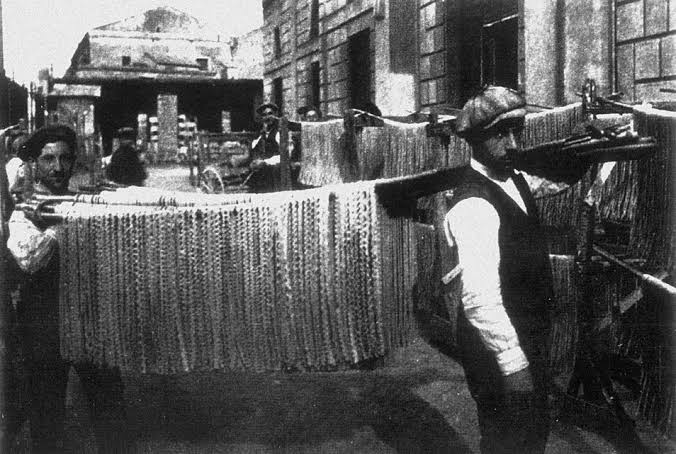
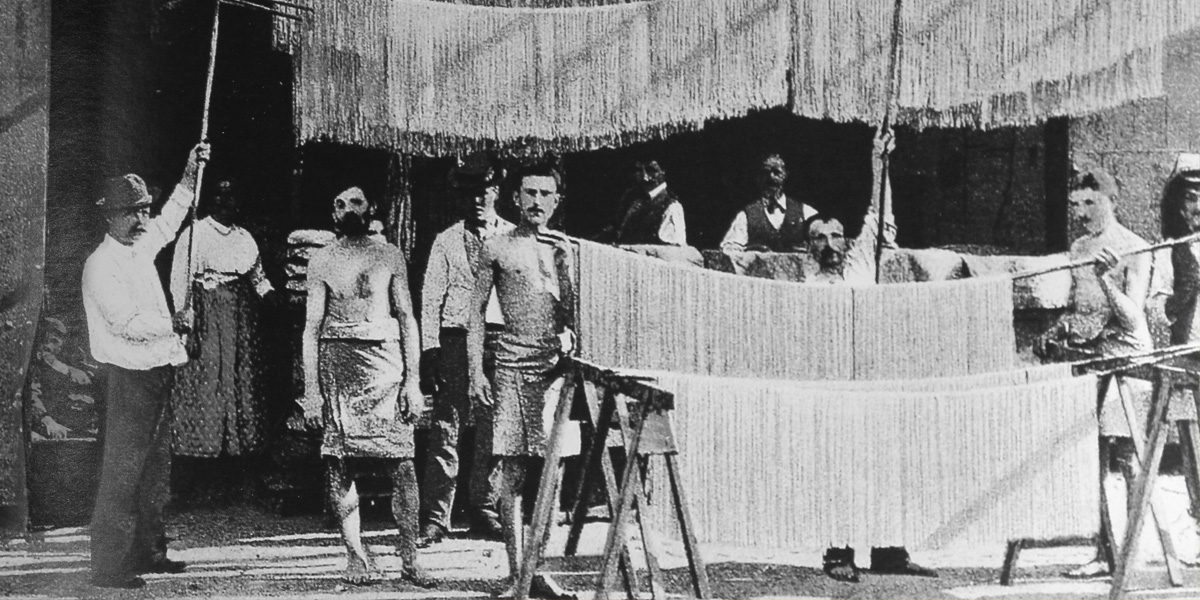
And it was precisely in the drying process that the first great secret lay. The pasta was laid out on long cane poles or wooden frames and left to dry in the alleyways or on the beaches, caressed by the sea breeze. The alternation between the warm southerly wind and the cool evening breeze created a slow, natural drying process, which sealed in the starches and gave the pasta that firm, chewy texture that holds up well during cooking, the very quality that would make it famous.
The limits of beauty
Whilst the quality of the coastal product was unrivalled, the nineteenth century brought with it a challenge that could not be overcome by the sheer skill of craftsmanship alone. The advent of the Industrial Revolution and the staggering rise in domestic demand, driven by the spread of pasta consumption across all social classes in the Kingdom of Naples, called for a change of pace.
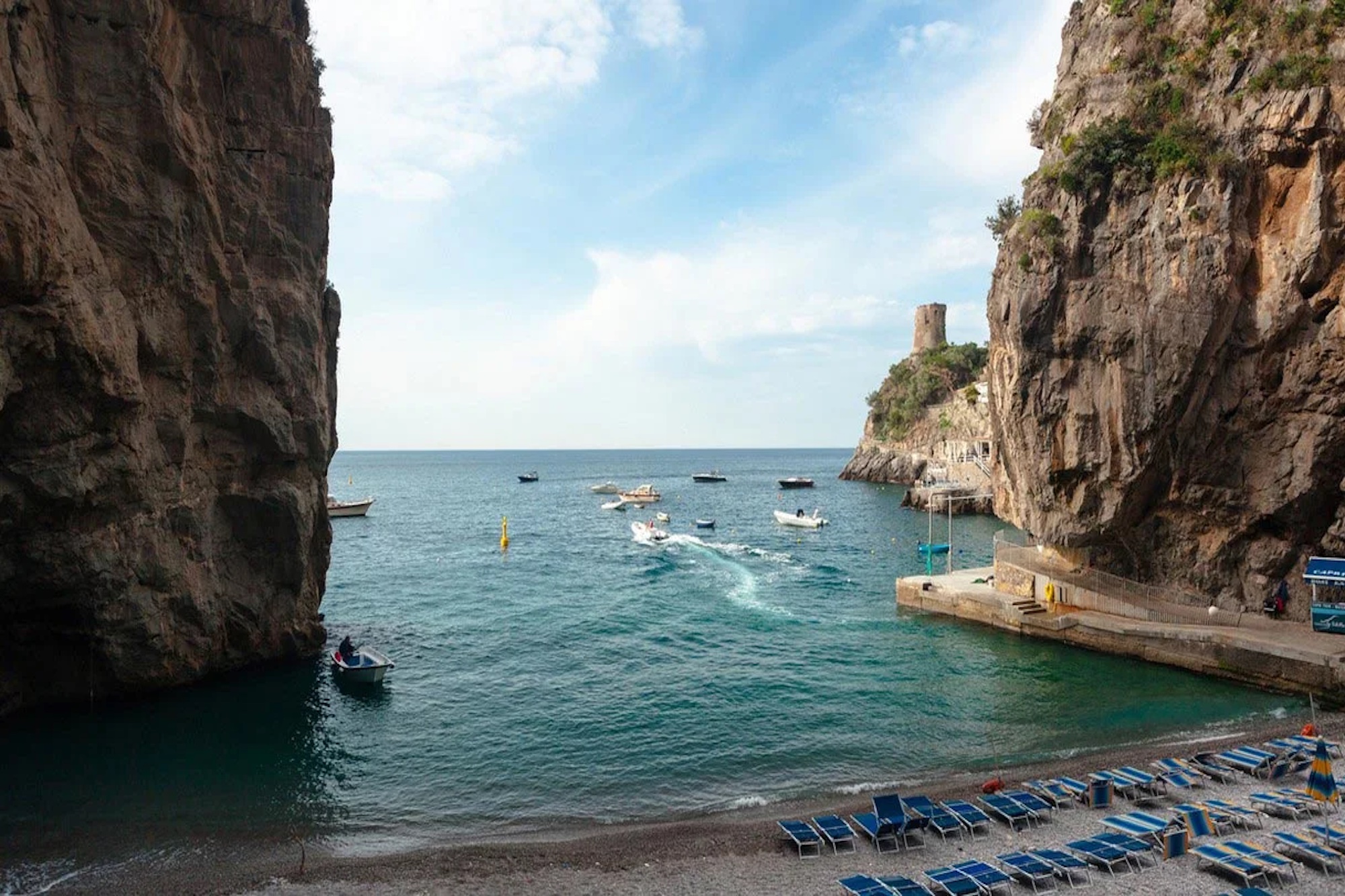
It was at this precise moment in history that Amalfi and Minori found themselves held captive by their own, unrivalled geographical layout. The coastal terrain offered no physical space for expansion, and building larger pasta factories was therefore impossible. Setting up kilometres of outdoor drying racks, essential for large-scale production, was a pipe dream in villages where every square metre of flat ground was already occupied by houses or churches. The rugged terrain, which for centuries had protected the coast from Saracen invasions, suddenly became a logistical prison.
The rise of Gragnano
Production inevitably had to move elsewhere, but without losing its soul or the accumulated know-how. The answer lay on the very other side of the Lattari Mountains, in Gragnano. This agricultural village possessed everything the Amalfi Coast lacked to make the industrial leap, combined with a climatic miracle found nowhere else.
Gragnano offered ample space and, above all, the Valle dei Mulini, through which the Vernotico stream flows, capable of powering dozens of enormous millstones with a constant flow of water. But the true stroke of genius, the factor that transformed Gragnano into the pasta capital of the world, was its urban architecture combined with the terrain.
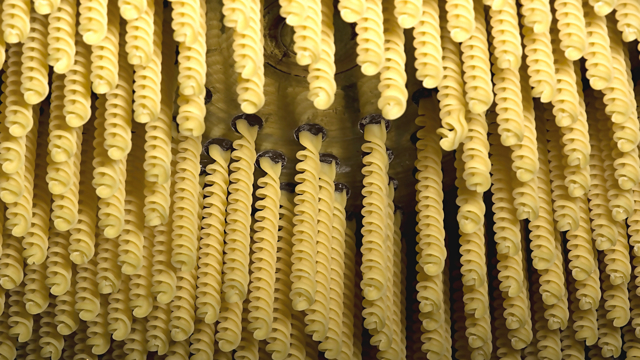
The town centre, and in particular the very central Via Roma, was literally redesigned and oriented according to the wind. The funnel-shaped layout of the valley caused the breeze from the Gulf of Naples to converge with the cold, dry air descending from the Lattari Mountains. This symphony of air currents created a natural wind tunnel along the town’s streets, ensuring perfect, slow and constant drying – vital for preserving the product. The streets were filled with endless stretches of ziti and macaroni hung out to dry in the sun, transforming the town into a huge pasta factory.
The definitive seal on this handover came in 1845, when King Ferdinand II of Bourbon, during a visit to Gragnano, tasted the local pasta and was so impressed that he granted the Gragnano manufacturers the exclusive privilege of supplying the court of Naples. It was the crowning moment. The arrival of the railway at the end of the century did the rest, swiftly connecting the
pasta factories to major markets and ports for export to the Americas, whilst the Amalfi Coast remained an isolated paradise, accessible only by sea or via rugged mule tracks.
A shared legacy
The shift in production from Amalfi to Gragnano should not be seen as a defeat, but as the natural evolution of a shared body of knowledge. The two sides of the Lattari Mountains have always been closely intertwined. The master pasta-makers from Amalfi and Minori brought their ancient techniques, their knowledge of bronze dies and the art of blending semolina to Gragnano. At its very core, the soul of Gragnano pasta preserves the genius of the Maritime Republic.
Even today, the bond between these regions remains unbreakable. Choosing to sit down to a meal on the Amalfi Coast means becoming part of this ancient tale, where the savoury essence of the sea meets the rustic character of wheat crafted to perfection.
Experience history with Dimore De Luca
For us, hospitality is the means through which we give voice to these stories. Staying at one of the Dimore De Luca properties is not merely a holiday, but an invitation to connect with the truest identity of our land.
Now, when you savour a plate of steaming maccaroni allo scarpariello, you won’t just be enjoying a convivial moment. Knowledge enriches our lives, and food is no longer mere sustenance or folklore when it is enriched by the flavour of the events that have helped to shape not just a region, but an entire country.
We look forward to guiding you, step by step, on a journey of discovery through the stories that make the Divine Coast a place of the soul.
