The history, myth and rituals of a city that never turns its back
There is a particular time of year when Salerno reveals its deepest, most intimate and vibrant essence. It is the third week of September, when summer gradually begins to give way to autumn. For the people of Salerno, September 21 is far more than just another date on the calendar: it is the day around which the history, identity and sense of belonging of an entire community revolve. It is the Feast Day of Saint Matthew, the city’s patron saint.
For us at Dimore De Luca, being custodians and passionate connoisseurs of this land means, first and foremost, opening the doors to its most authentic traditions. If you have the opportunity to visit Salerno at this time of year, here is how to understand and experience the true spirit of this celebration.
The September sea and the city’s ancient rhythm
For those born and raised in Salerno, the beach season follows a very precise calendar: it begins at the end of May and traditionally comes to a close on September 21. Until then, the sea remains at the heart of everyday life, with bright sunny days, sunset swims and the gentle warmth that accompanies the final dips of the season.
Staying in Salerno in September offers the opportunity to experience the coast at a slower, more intimate pace, when the beauty of the seascape meets the first crisp breezes announcing the arrival of the feast days.
August 21: the raising of the cloth and a promise of protection
The anticipation begins well in advance. As the end of August approaches, the warmth of late summer mingles with the scent of the sea and a growing sense of excitement that spreads through the historic streets, from the laundry hanging above the alleys of the Fornelle district to the tables of Largo Campo.
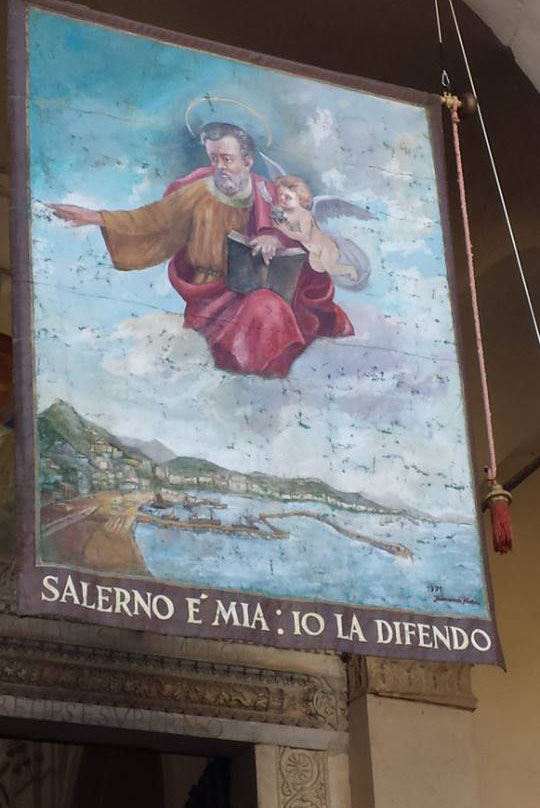
On August 21, exactly one month before the feast day, the atrium of Salerno Cathedral fills with people of every generation: from elderly residents who embody the living memory of the historic center to children sitting on their fathers’ shoulders. Suddenly, the solemn silence is broken by the first toll of a bell, as a heavy cloth is slowly raised towards the sky. This is the ritual known as the alzata del panno, the raising of the cloth, emblazoned with the words: “Salerno is mine, and I will defend it.”
This is far more than folklore. It represents a bond of identity between the patron saint and the people of Salerno. The ritual recalls the legend according to which Saint Matthew summoned a storm to drive back the ships of Barbarossa, reaffirming the Apostle’s role as guardian and protector of the city.
A thousand-year journey from Cilento to the Cathedral of the Popes
That first toll of the bell marks the beginning of a thirty-day countdown. The bond between the Evangelist and the Salerno area has ancient roots stretching all the way to the shores of Cilento.
According to historical sources, the Apostle’s remains arrived in the 5th century in ancient Velia, or Elea, the homeland of Parmenides. They were safeguarded by the monk Athanasius, first in Casal Velino and later towards Capaccio and Paestum, before finally reaching Salerno in AD 954 following the solemn translation ordered by the Lombard prince Gisulf I.
Inside the Cathedral is also the exquisite Gothic reliquary containing the arm of Saint Matthew, depicted in the act of blessing. During the feast days, the reliquary leaves its glass case for a moving journey through the city, bringing hope and comfort to places of suffering such as Ruggi Hospital and the city’s prisons.
Salerno Cathedral, founded by the Norman duke Robert Guiscard and renowned for its papal staircase of seven steps, is a monument of international significance. Consecrated by Pope Gregory VII, one of the most influential figures in the history of the Church, the Cathedral effectively became a papal seat during the exile of the reforming pontiff, who died here in 1085. Even today, his famous final words seem to echo through its naves: “I have loved justice and hated iniquity; therefore, I die in exile.”
The mystery of the “two faces”: art, liturgy and the Salernitan character
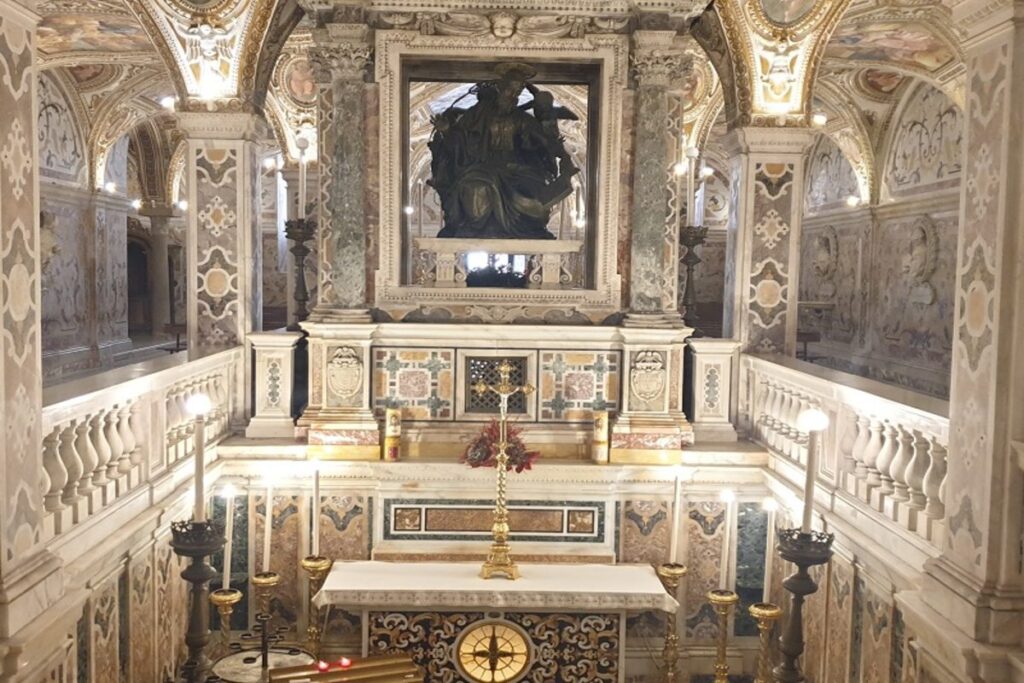
Descending into the Cathedral Crypt, a masterpiece of inlaid marble and 17th-century frescoes created by Domenico and Giulio Cesare Fontana, means entering the very heart of Salerno’s spiritual life.
There is a well-known local saying: “Salernitano doppia faccia come San Matteo” — “A Salernitan has two faces, like Saint Matthew.” Outside the city, the expression is sometimes misunderstood as a reference to duplicity. Yet its historical and artistic origins reveal an entirely different meaning.
In front of the Crypt’s high altar stands the famous double-faced bronze statue created in the early 17th century by Michelangelo Naccherino. The sculpture features two identical faces: one looking towards the entrance to the Crypt, the other facing the altar behind it. This was not merely an exercise in artistic virtuosity, but a practical liturgical solution: it allowed the celebrant behind the altar to look Saint Matthew in the eyes, while ensuring that the faithful in the nave would never see the patron saint’s back. Saint Matthew watches over everyone, from every angle, and never turns his back on anyone.
From a theological and human perspective, Matthew is also historically a saint of two lives. Before answering his calling in Capernaum, he was Levi the publican, a tax collector who handled money on behalf of the Roman Empire. He later became the Apostle and Evangelist whose life was defined by testimony and martyrdom. He has two faces because he experienced an earthly, pragmatic existence before embracing a spiritual one.
For the people of Salerno, the metaphor of the “two faces” therefore evokes intellectual shrewdness, adaptability and resilience. These are the characteristics of a seafaring people living at a historic crossroads, accustomed to looking at the world from different perspectives and overcoming adversity through ingenuity.
The aromas of tradition and the solemn procession
Walking through the streets of Salerno’s historic center in the days leading up to September 21, the atmosphere becomes infused with the aromas of local cuisine. The air is filled with the distinctive scent of milza alla salernitana, a traditional spleen dish prepared with vinegar, mint and chili pepper according to a centuries-old recipe.
In Salerno, the sacred and the secular coexist in a natural balance. Devotion to the Evangelist is inseparable from the people’s love for their city — so much so that Saint Matthew himself appears on Salerno’s municipal coat of arms.
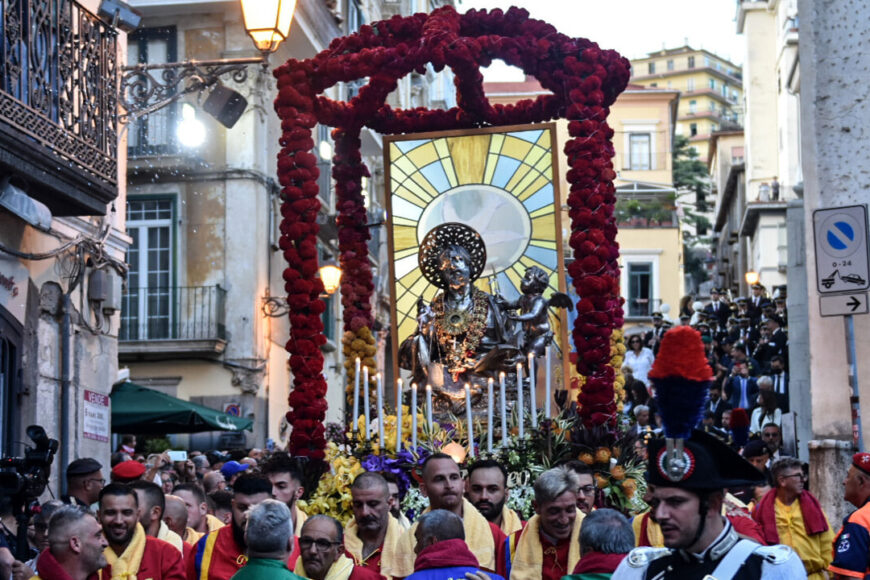
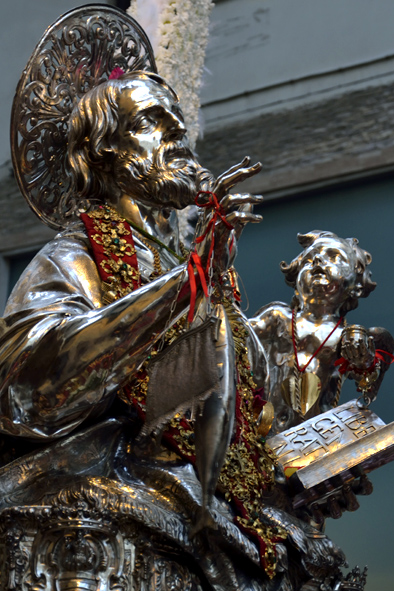
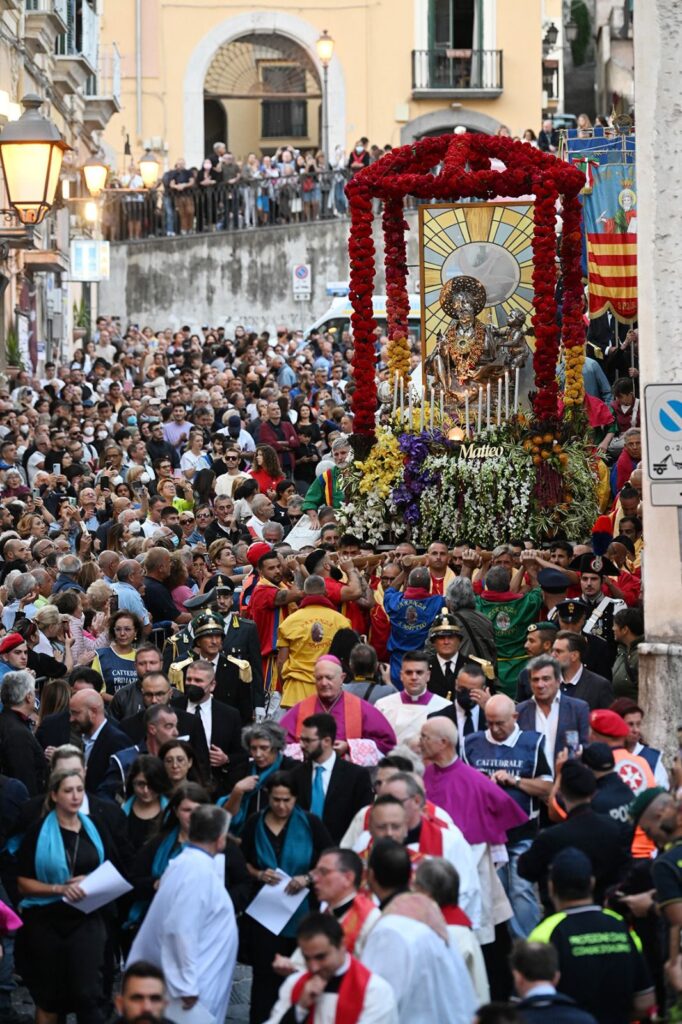
The culmination of the celebrations is the solemn procession on September 21. The silver statue of Saint Matthew is carried on the shoulders of devotees out of the Cathedral and through the streets of the city center, accompanied by an emotional and deeply involved crowd. One of the most significant moments is the stop at the City Hall, a symbolic gesture through which the patron saint greets and extends his protection over the entire community.
Experience Saint Matthew’s Feast with Dimore De Luca
Whether you are captivated by the emotion of the procession, eager to discover Salerno’s culinary traditions, or simply looking forward to enjoying the tranquility of the September sea, experiencing the Feast of Saint Matthew means discovering the most authentic soul of Salerno and its people.
At our properties in Salerno, we offer an ideal base from which to experience these extraordinary days from a privileged position, allowing you to stay in the city not simply as a tourist, but as a welcomed guest immersed in the authentic story of our land.