In Amalfi, between the golden mosaics and the darkness of the sea, one finds oneself in silence
There is a precise moment when Amalfi ceases to be part of the world’s news cycle and becomes a relic. It happens when the last electric light gives way to darkness and the city, stripped of its mask as the pearl of global tourism, returns to being a stone womb, a tomb carved into the limestone of the Valle dei Mulini. Good Friday is not merely a liturgical observance, but a journey into memory that transforms every alley, every staircase, and every fragment of peeling plaster into a cell of collective meditation. The air grows thick, saturated with the acrid smell of burning wax and that salty breath rising forcefully from the sea, reminding the observer that here the sacred and the profane are bound by the same immutable sailor’s knot. It is not a parade; it is a planned urban eclipse, a moment when the community decides to shut itself down so it can finally look within, in a silence that has the weight of lead and the transparency of glass.
This dramatization of suffering did not arise by chance; rather, it has its roots in the 17th century, in that Spanish Baroque style which found the most fertile ground in the Kingdom of Naples to graft sacred drama onto the raw flesh of the people. Archival records whisper of a brotherhood officially founded in 1631, when the Archconfraternity of Our Lady of Sorrows inherited the mission of the earlier Cinturati. It was not merely an act of faith, but a lifeline rooted in the fabric of society: participation in the ritual guaranteed membership in a collective body, a code of spiritual conduct that offered protection and identity in an era of global uncertainty. Under the impetus of the Council of Trent, the Church realized that to speak to the masses, it needed theater—a representation of sentiment that transformed penance into a total public event. Amalfi, with its impossible verticals and covered passageways, was the perfect stage for this alchemy of the sacred, where the accumulated treasure was not money, but collective devotion.
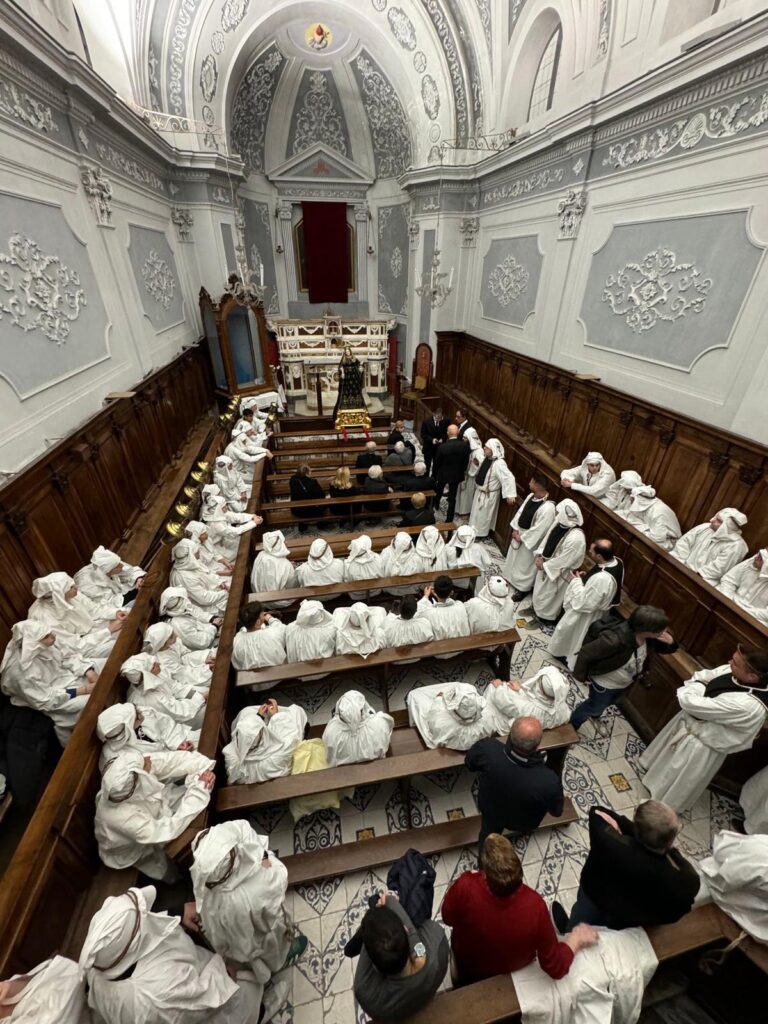
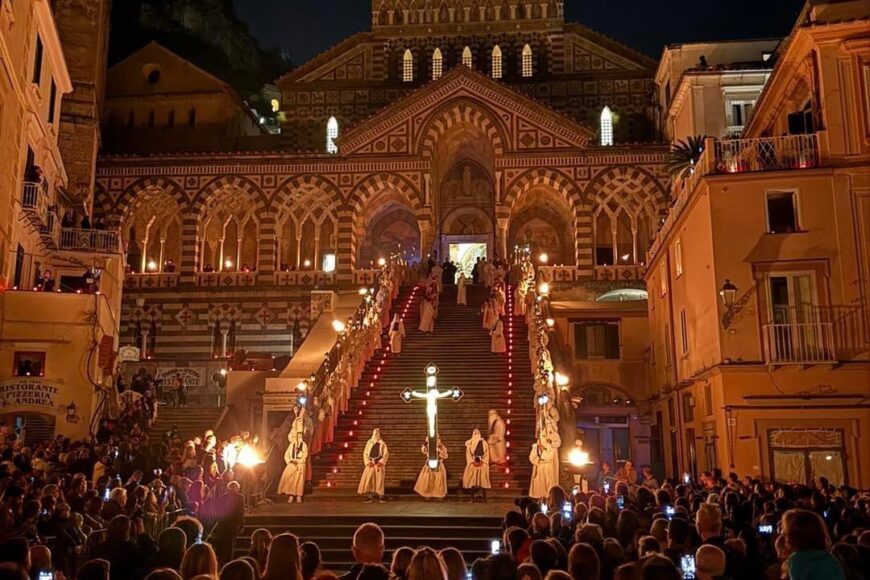
The silence that accompanies the procession is a tangible presence, broken only by the rustling of the brothers’ white robes. They are ghostly figures with their faces concealed by the buffa, the hood that erases individual identity to merge them into a single penitent entity. In ancient times, this anonymity was not merely an exercise in humility, but an arcane discipline of dignity: in the face of death, the nobleman and the fisherman became indistinguishable, settling their accounts with life in a rite that admitted no visible hierarchies. They carry the schiabica on their shoulders, a term that even today evokes fishing nets and archaic toil. In the language of their forefathers, the schiabica was the trawl net, the tool with which the people of Amalfi for centuries wrested life from the abyss. Applying this term to Christ’s funeral canopy means loading the Savior onto the city’s boat, making the sacrifice a matter of the sea, of waves, and of salt.
If the movement of the procession is the body, the *Miserere* is its labored breath. This is not merely a choral performance, but a melody rooted in oral tradition that has withstood scholarly musical reforms to preserve an archaic, almost visceral structure. The notes of Psalm 50 are not sung; they are extracted from the rock through a polyphony that seems to trace the movement of waves: there is a deep bass that serves as a backdrop and tenors that chase one another like foam on the crests. In this handling of the sound heritage, every modulation serves to dig into the listener’s chest, a system of emotional participation that requires no sheet music, but only memory. Local music historiography emphasizes how this tradition has been passed down from father to son like a navigational secret, a vocal compass to find one’s way in the darkness of the holy night.
The centerpiece of this nighttime procession is the body of the Dead Christ, an 18th-century wooden sculpture from the Neapolitan school that is a masterpiece of raw realism. The sculptors of the time, following a precise strategy of devotion, abandoned idealized beauty to embrace the truth of martyrdom. Under the livid glow of the torches, one can sense the tension in the tendons, the pallor of the skin that seems to turn to marble, the wounds that still appear to throb. It is the representation of an aesthetic sensibility that strikes straight to the heart: the viewer must not only admire, but must identify with the physical pain to understand the metaphysical. This approach transforms the simulacrum into a living presence, a castaway of history who is fished out every year from the waters of time to be carried in triumph and in tears.
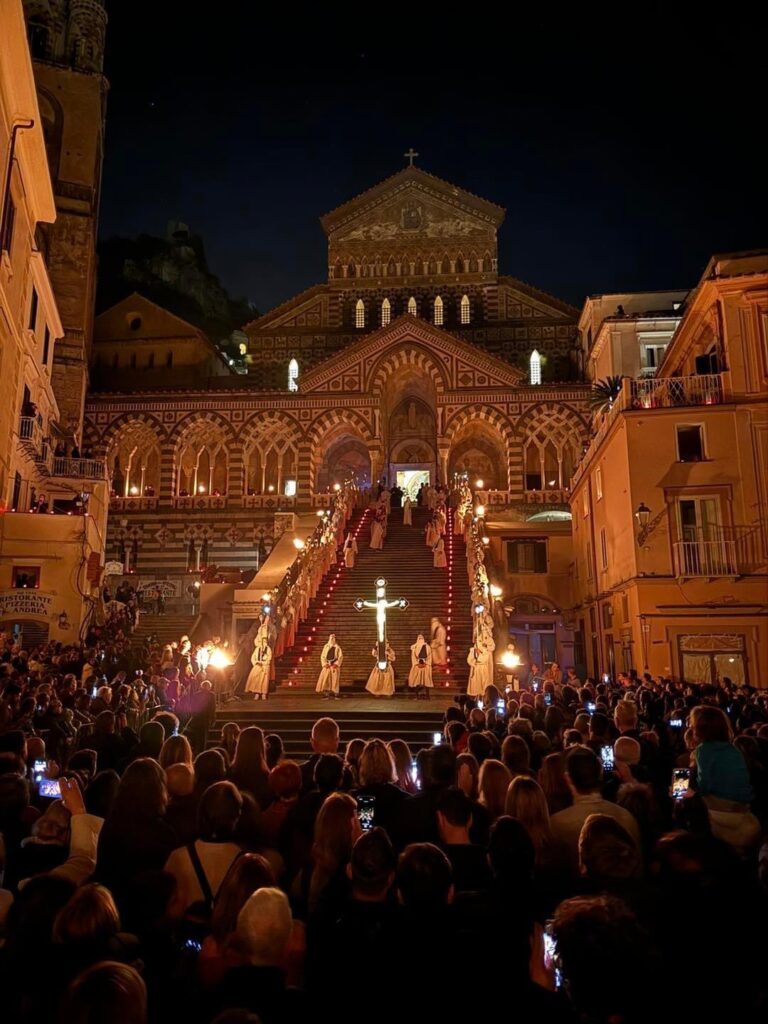
This fervor reaches its peak in front of the monumental staircase of the Cathedral of Sant’Andrea. Sixty-two steps separate the square from the mosaic façade, which, bathed in the flickering light of the flames, seems to come alive with a life of its own, as if the saints depicted in gold were about to descend to join the sea of people. The ascent of the bier is an exercise in brute strength and mystical grace that takes one’s breath away, a narrative climax in which the physical exertion of the bearers becomes a visible prayer. Here the encounter takes place, the moment when the narrative strategy reaches its peak emotional impact: the statue of Our Lady of Sorrows, wrapped in a black silk cloak that seems to absorb all the darkness of the night, follows the body of her son. It is a two-act drama unfolding under the gaze of the apostles, a temporal short-circuit where the Byzantine aesthetics of the mosaics embrace the Baroque sorrow of the square.
As the procession winds through the narrow streets like a stream of molten gold, the city lights up with thousands of earthly constellations. There is not a single balcony or ledge that does not host a small lamp, a tiny flame defying the coastal wind. It is a choreography of fire that redraws the contours of the Valle dei Mulini, making the houses appear suspended in mid-air, as if Amalfi itself were an immense illuminated ship ready to set sail toward eternity. In this setting, managing the event is not merely an organizational matter for the brotherhoods, but an act of protecting an intangible heritage at risk of erosion. Every step the bearer takes, every vibration of the voice in the choir, every single drop of wax that marks the marble is a piece of a story meant not only to be written in books, but to be lived on the skin and in the soul.
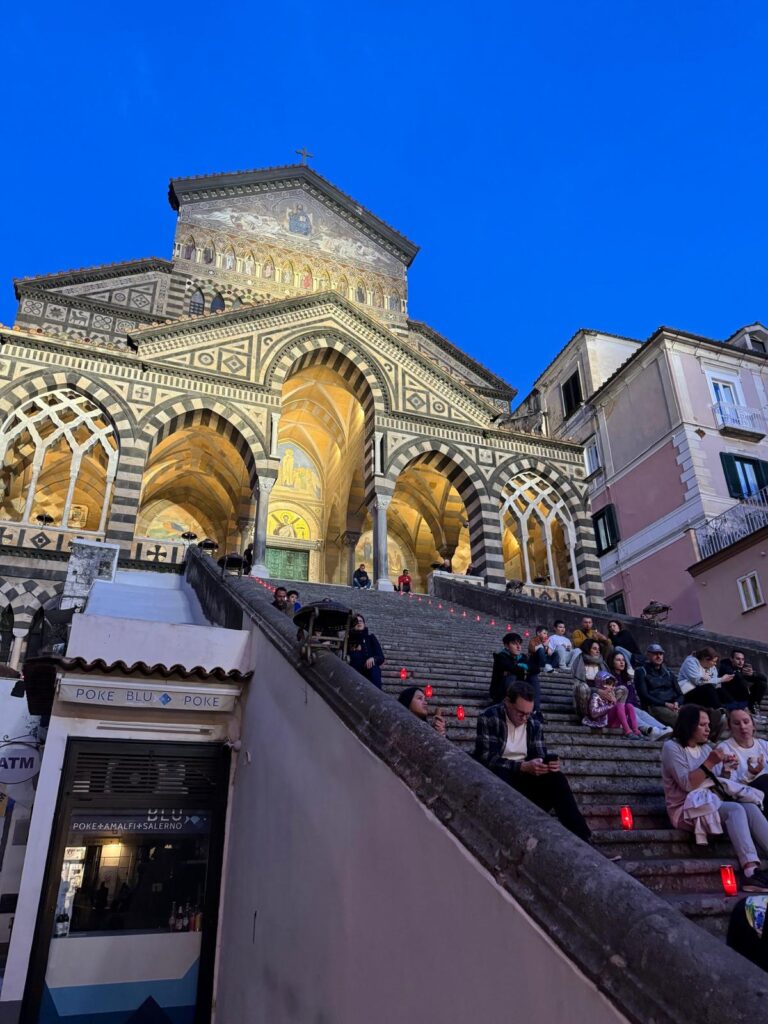
Today, watching that stream of light glide between the white houses, one senses that the Good Friday procession is much more than a historical legacy. In an age racing toward the dematerialization of every experience, Amalfi chooses to return to something tangible, physical, and material. The logic driving this complex machine is not measured in likes or views, but in a sense of continuity and belonging. Every participant, from the child clutching his torch to the elderly man singing the Miserere in a cracked voice, is a guardian of this town’s identity. The beauty of the ritual lies precisely in its ability to be, at the same time, a monumental public event and a deeply private experience—a moment when the city looks in the mirror and recognizes itself as intact.
When the procession finally returns and the city lights begin to come back on, a strange sense of melancholy lingers—the kind felt by those who have witnessed a secular miracle and never want to return to reality. The shadows recede, tourists resume speaking loudly, and daily life reclaims the streets, amid cafés and souvenir shops. But for those who can look beyond the surface, Amalfi’s silence remains there, hidden in the folds of the rock, among the Gothic arches and Saracen arcades, waiting for the next Friday when time decides to stand still once more. What remains is the memory of a city that, for a few hours, chose to be an open-air sanctuary, reminding us that light—true light—always needs a little darkness to shine with all its devastating beauty.